

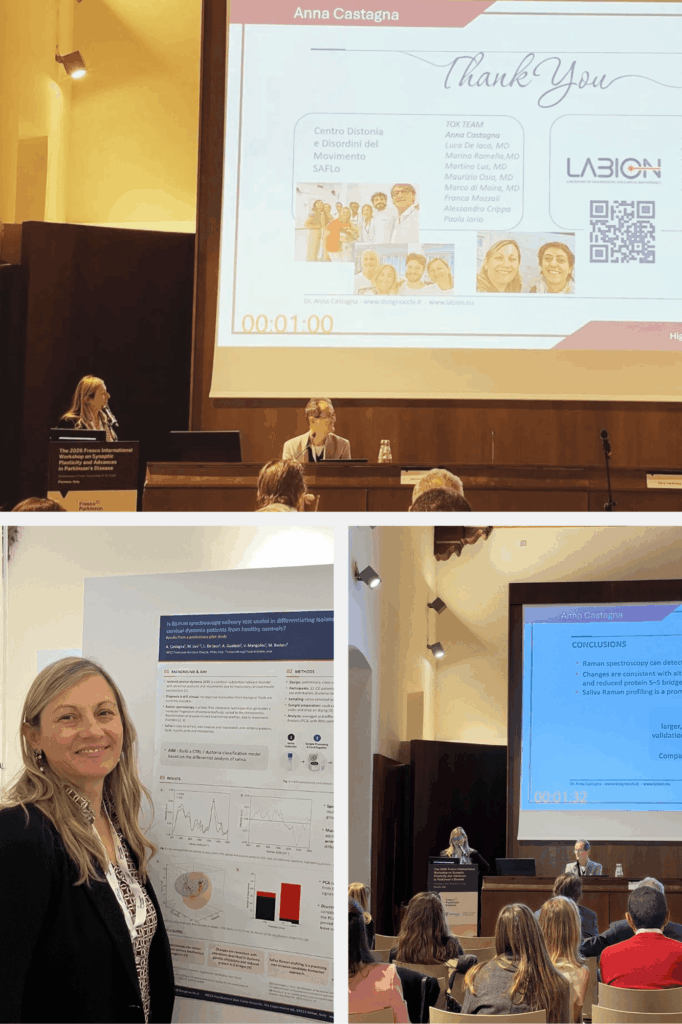
We warmly thank Dr. Anna Castagna for presenting the exploratory data generated at LABION at the 2026 Fresco International Workshop on Synaptic Plasticity and Advances in Parkinson’s Disease, held in Florence on November 4–6, 2026.
The workshop brought together researchers and clinicians from around the world to discuss the latest advances in synaptic plasticity and movement disorders. It was an ideal setting to share our recent findings with the scientific community.
The collaboration between LABION and Anna Castagna has a long history, and it has recently led to exploratory but promising results on the biochemical fingerprint of dystonia in saliva.
Why Saliva?
Saliva is a non-invasive, easily collected biological fluid, which makes it an attractive source of potential biomarkers, especially for conditions that are hard to diagnose and monitor.
What is dystonia?
Dystonia is a neurological movement disorder characterized by sustained or intermittent involuntary muscle contractions. These cause twisting, repetitive movements and abnormal postures, and can affect a single body region or the whole body. It can significantly impact quality of life, and diagnosis is often delayed because symptoms can be mistaken for other conditions.
A rare disease
Dystonia is considered a rare disease, with its different forms affecting a small proportion of the population (in Europe, a disease is defined as rare when it affects fewer than 5 in 10,000 people). Research on rare diseases is often limited by small patient numbers and scarce resources, which makes collaboration between research groups and clinicians essential.
These results are still preliminary, but they open the way to further studies aimed at validating the findings on larger cohorts. In the long term, this work may contribute to identifying non-invasive biomarkers to support diagnosis and patient monitoring.